College Counselor: Are college fairs worth it?
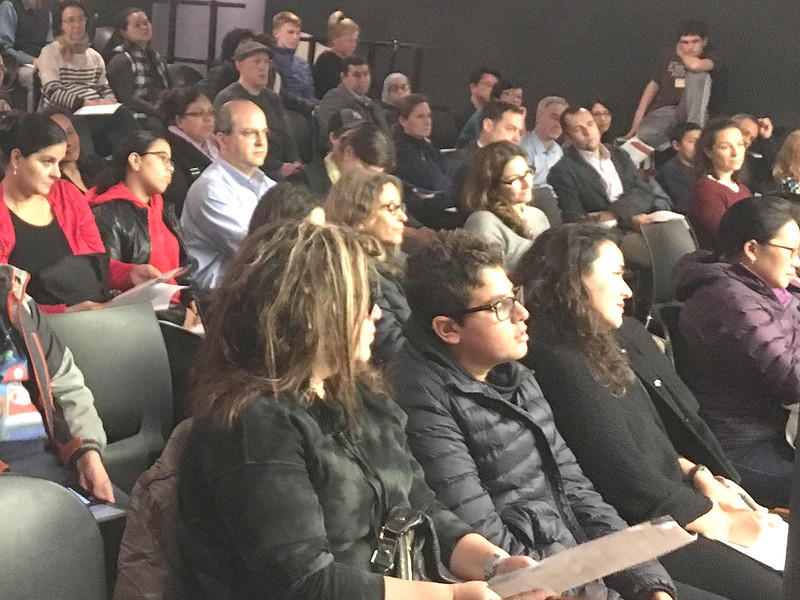
Q: Is there any point in going to a college fair? I went to the NACAC fair held last week at the Jacob Javits Center in Manhattan. My friends and I waited on line for half an hour just to get in! Then there were hundreds of booths, and huge crowds, and colleges I’d never heard of. The colleges I had heard of had lots of people crowded around so you couldn’t really get to talk to the reps. I got a lot of brochures, but don’t feel I gained any in-depth knowledge about the schools.
A: There are many types of college fairs, and the one you went to is not designed to provide ”in-depth knowledge” but rather to give a huge array of colleges and universities exposure in a large urban market. That is why these large NACAC fairs are held in major cities across the country. For most students, this will be their first exposure to the many possibilities out there in the word of higher education. It’s a good place to start, to browse, and get a general idea. So the purpose of this was to 1) provide publicity for the colleges and 2) to get students to write, go to the website or visit for more information.
Apply for city's summer youth job by May 10
If you are between the ages of 14 and 24, you may apply by May 10 for the New York City Summer Youth Employment program.
Participants work up to 25 hours a week for seven weeks, earning $7.25 per hour. Job sites include government agencies, hospitals, summer camps, nonprofits, small businesses, and retailers. See the NYC Department of Youth & Community Development website for more information and an application.
Still looking for a free summer program for your teen? The Long Island University campus in Brooklyn has several programs that still have space, including one for budding accountants, another on college readiness, a third for artistic kids who will learn to draw and paint from professional artists and a fourth for coursework and class trips on writing, speaking, critical thinking, research and creativity. The Fort Greene-Clinton Hill Patch gives a rundown, including contact information for each program. Deadlines have been extended until June.
Ask Judy: How to prepare for 9th grade?
Dear Judy: My son was accepted to Beacon High School. He is very happy and is already making plans as to what he will do at the new school. I don't come from the U.S. and my question is: Is it a good school? How can I help him prepare for his first year? He doesn't know yet what profession he wants to pursue when he goes to college.
Spanish-speaking dad
Dear Dad:
I am glad to hear that your son is pleased with his high school placement. Beacon is a very good school and it will prepare him well for university studies. Universities in the United States do not require students to choose what they will focus on until they are well into the second year of the four years they will spend there. High school years can be used for exploring many subjects and possible careers. That's why, to graduate, students must earn 44 credits for academic courses in math, science, social studies, English, a non-English language, art, music and physical education. Beacon is a member of the New York Performance Standards Consortium, and, as such students are exempt from taking most state exams called Regents. Instead, course credits are based on detailed projects called portfolios which students present to their teachers and peers.
Beacon graduation requirements are online. You can compare these to the city's Department of Education requirements listed on the website. And, when the time comes, there is a very helpful guide to preparing your child for college: Your Children Can Go to College...Yes They Can!" [PDF] which was developed by the New York Immigration Coalition. It's available in English and Spanish.
But, right now, turn your attention to helping your child prepare for entering 9th grade in September. Like many city high schools, Beacon will have a summer orientation, where your son will visit the school, get any summer assignments and suggestions as to how to prepare for 9th grade. There may be a reading or writing assignment. There he will also meet other 9th graders. If your son is to travel to school via public transportation, help him learn the route and practice the trip. He should time the door to door travel during early morning --when getting there on time is so important. The school may be able to help you get in touch with other students traveling from your neighborhood.
Finally, as summer winds down, try encourage him to follow a sleep schedule that he will need to arrive at school ready to learn.
Good luck to your son for a great high school experience.
Judy
College Counselor: Is an 'honor' worth the expense?
Q: My son just received an impressive-looking envelope inviting him to participate in the National Student Leadership Conference in Washington, DC. They make it sound like going will be a great thing for him to put on college applications, but will it really count that much? Will it open doors for him? If this is truly a great opportunity, I don't want him to miss out – but it's really expensive! What do you suggest?
A: Would participating in this program be exciting for your son? Probably so. Will participating add a line to his resume that will make a real impact on his college applications? The company organizing the program would like you to think so, but the real answer is: no.
New website helps teens get ready for college
Want to find out how to apply for college financial aid? Trying to decide whether a community college is a better option than a four year school? Is there a free college counseling program in your neighborhood or borough? NYC College Line, a website that officially launched Wednesday, tackles these questions and more.
Funded by the Gates Foundation, NYC College Line provides resources to help New York City students get into and stay in college. It's a collaborative project between CUNY's Graduate NYC!, the City University of New York, the NYC Department of Education, and the Options Center of Goddard Riverside.The goal of the Graduate NYC! College Readiness & Success initiative is to double the number” of CUNY graduates by 2020.
“We want students not just to get into college, but to be successful there," said schools chancellor Dennis Walcott in a press release. "NYC College Line will help us achieve both of those goals. It’s a win-win – for students, educators, and this city.”
Many public high schools have too few college counselors to meet the needs of seniors applying to college, and so NYC College Line may help breach the gap. It allows students to get quick answers to many typical questions. In addition to the resources listed online, users can log on and ask questions directly of experts and find out about upcoming events such as financial aid workshops or college fairs. There are also online training sessions for professionals.
Read more about the launch here and check out the new website here.
Filling out FAFSA? Here's a how-to guide
Filling out the Free Application for Federal Student Aide (FAFSA) is the first step for students seeking financial support to go to college.
But completing the form is a perennial headache. Even the first step -- finding the right form online -- is confusing because the Web is populated with imposters. That's why the Center for New York City Affairs and Insideschools released FAFSA: The How-To Guide for Students and the Adults Who Help Them. The illustrated guide was designed to help students and families navigate the sometimes confusing federal financial aid process.
FAFSA: The How-To Guide was written in partnership with college guidance and financial aid professionals and funded by the Capital One Foundation. It is particularly relevant to students who are the first in their families to be going to college. The guide explains how to prepare for the form, what kinds of questions will be asked, and why the government needs the information on parents, families and income.
The guide also addresses complicated questions that first generation students might have, such as: how the FAFSA form defines parents and families when students don't live with their parents and how to fill out the FAFSA form if a parent or student is undocumented.
Click here to download a PDF of the guide and visit the Center for New York City Affair's website to order a copy (or copies) for yourself, your family or your students.
Quinn: less test prep, more collaboration
Council Speaker Christine Quinn said she would focus less on standardized tests, give parents a stronger advisory role and extend the school day for low-income children if she is elected mayor.
You can watch her entire speech and Q&A session, sponsored by The Center for New York City Affairs (our parent organization) and Insideschools.org at the New School, here.
Without criticizing Mayor Bloomberg, Quinn implied that, if elected, her administration would depart from some of Bloomberg's education policies. While Bloomberg has focused on standardized tests as a way of measuring progress, Quinn said "testing should not be more important than teaching" and should not define schools. While Bloomberg has fostered competition among schools to outperform each other, Quinn said her administration would instead promote more collaboration by identifiying what is working and encouraging schools to share best practices. She pointed to New Dorp High School's literacy program as an example of something that should be expanded to other city schools.
Charter schools are here to stay, Quinn said, but she suggested she would not expand their numbers significantly. "They're at a good level right now," she said. She pledged support to large high schools like New Dorp or Truman High School. Bloomberg's Education Department has closed dozens of large high schools in the Bronx and Manhattan, breaking them into smaller schools. Quinn said she supports the small schools, but large schools can be successful as well.
On the topic of closing schools, Quinn said she would like to see earlier intervention and mentioned a "red alert" system she would put in place to support "failing schools." "Instead of treating schools closings as a good in and of itself, we will treat it as a last resort," she said.
In another departure from Bloomberg, parents under the Quinn administration would have a stronger advisory role. She would like Community Education Councils to be elevated to the status of Community Boards, which advise city government on land-use. She said she's undecided on the topic of school networks, and welcomes parent input. The Bloomberg administration dismantled school districts based on a geographical area and replaced them with "networks" that may include schools from a number of boroughs.
Notably absent from her speech were mentions of the teacher's union, except to say both sides should "lower the temperature" on the debate over teacher evaluations. She also was mum on special education, which the city has begun to overhaul.
Future of NYC schools event with Quinn
On Tuesday, Jan. 15, Insideschools and the Center for New York City Affairs will co-host a conversation with City Council Speaker Christine Quinn on the future of schools in New York City.
Quinn will discuss her vision for "building a 21st century school system," including college and career readiness. She will also participate in a Q & A with Insideschools' founder and senior editor, Clara Hemphill. This event is one of a series of events with potential 2013 mayoral candidates sponsored by the Center for New York City Affairs at The New School. (See a write-up of a 2012 event with mayoral hopeful Tom Allon here.)
Quinn also spoke about city education policy, along with other potential mayoral candidates, at a GothamSchools event in November. See a rundown of that event here.
The Jan. 15 forum will be at The New School, at 65 West 11th Street, from 8:30 am to 10 am. Tickets are free but you must reserve a seat; RSVP here: http://strongerschools.eventbrite.com/. Do it soon! It's a small venue and seats are going fast.
Ask Judy: Don't judge a school by its grade
Dear Judy
We are researching schools for our child who will be entering kindergarten next year. All the reviews I’ve read have been wonderful; the teachers, the principal, kids, parents, new math program. So I was a bit surprised that it had a low grade on the 2011-12 NYC DOE progress report. Cou you could offer any more insight?
Prospective parent.
Dear Prospective parent,
Your experience confirms ours: don’t judge the school by its letter grade alone. The letter on a school’s report is shorthand for a number of different measures and it helps to have some technical knowledge and persistence to understand it. Your question is a timely one not only for families applying to kindergarten but for 8th graders looking for a high school too. High School Progress Reports for 2011-2012 were released yesterday!
College Counselor: Early decision or not?
Q: I am trying to decide if I should apply to college Early Decision. I visited a few colleges over the summer, and saw three that I really like. I have a GPA of about 91, pretty decent SATs, and Regents scores in the 90s. My counselor says I have a good shot at several SUNY colleges, maybe even honor programs, and some other schools. My question is, will applying Early Decision to the private colleges give me a better chance of admission? A lot of my friends are saying that applying early shows interest, so you have a better shot at getting in.
A: Filing an Early Decision application is a huge commitment. You should do so ONLY if 1) you are absolutely, completely, 100% in love with a particular school, and 2) financial aid is not a priority.
Early Decision acceptances are binding, and under the terms of the decision you will not be allowed to wait and see if you are admitted elsewhere. Neither will you have the opportunity to weigh different financial aid offers. If you are accepted to a school under Early Decision, you are committed to enrolling there.